
fatbus
Real analogue mastering hardware, captured with signature response modelling for your mixbus.
Achieve a higher perceived LUFS level while retaining the same peak level. Plus six tonal controls to shape the colour. Make your master louder with style and character.
Measured with purpose.
Refined by listening.
- Instant download
- Licence key by email
- 7-day free demo

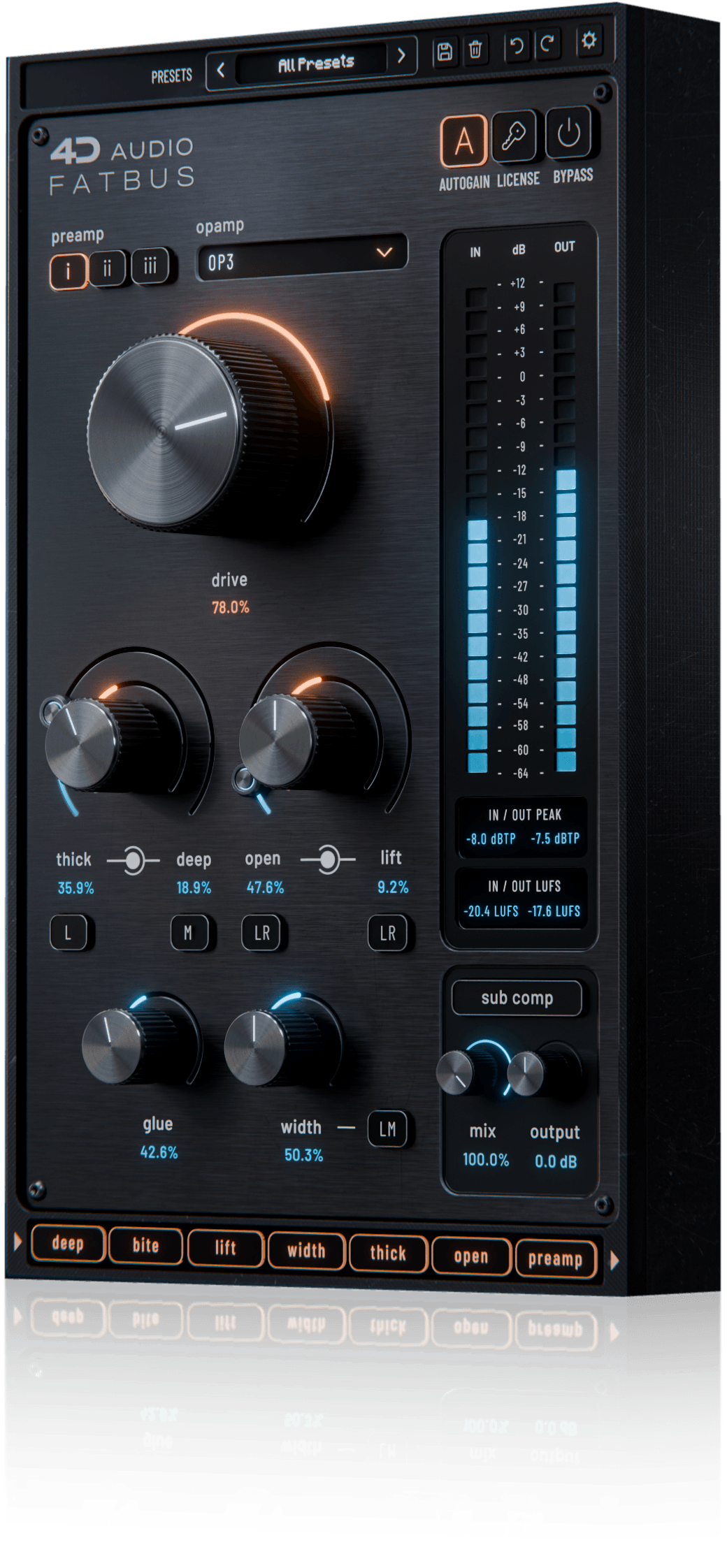
Every control is real hardware.
Feed a mix through preamps, transformers and opamps and it comes to life. Fatbus gives you three preamp flavours, switchable opamp models and six tone controls lifted from mastering-grade analogue boxes. Lows that sit deeper, valve style thickness, air, open British-style brightness, tape glue and stereo width.
Like with hardware, the Fatbus preamp will react differently depending on the level of audio it is fed. For example Fatbus being used on a mix which peaks at -1dBFS will see more apparent peak level reduction compared to a mix at say -10dBFS.
Our signature response modelling captures real outboard gear, allowing fatbus to add weight, width and perceived level without pushing your peak level. Imparting tonal flavour, image detail and drive where a standard clipper falls short.
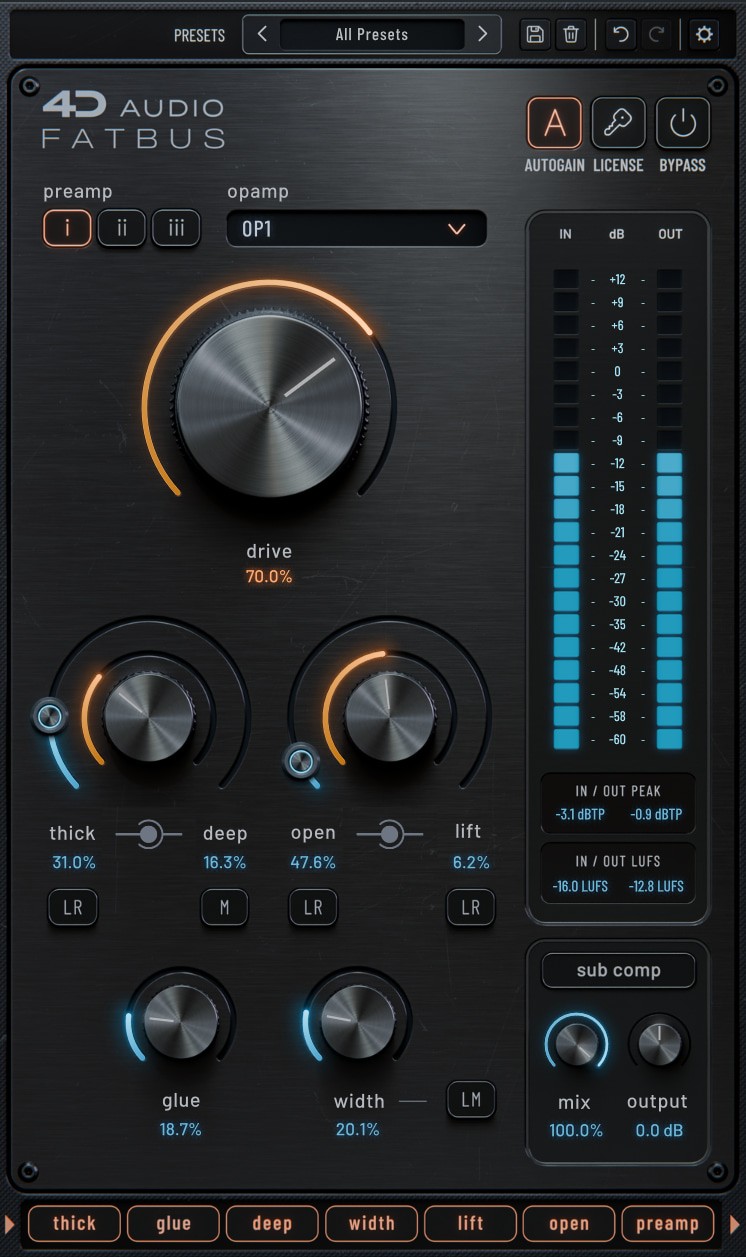
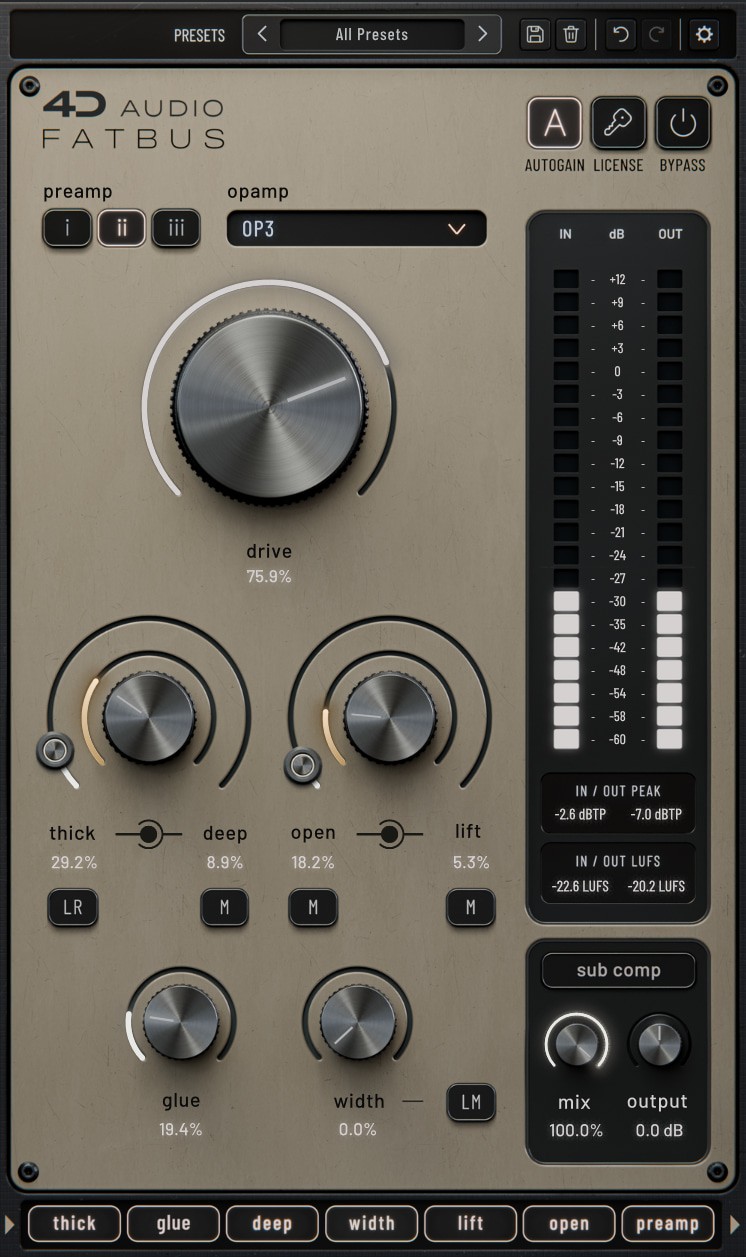
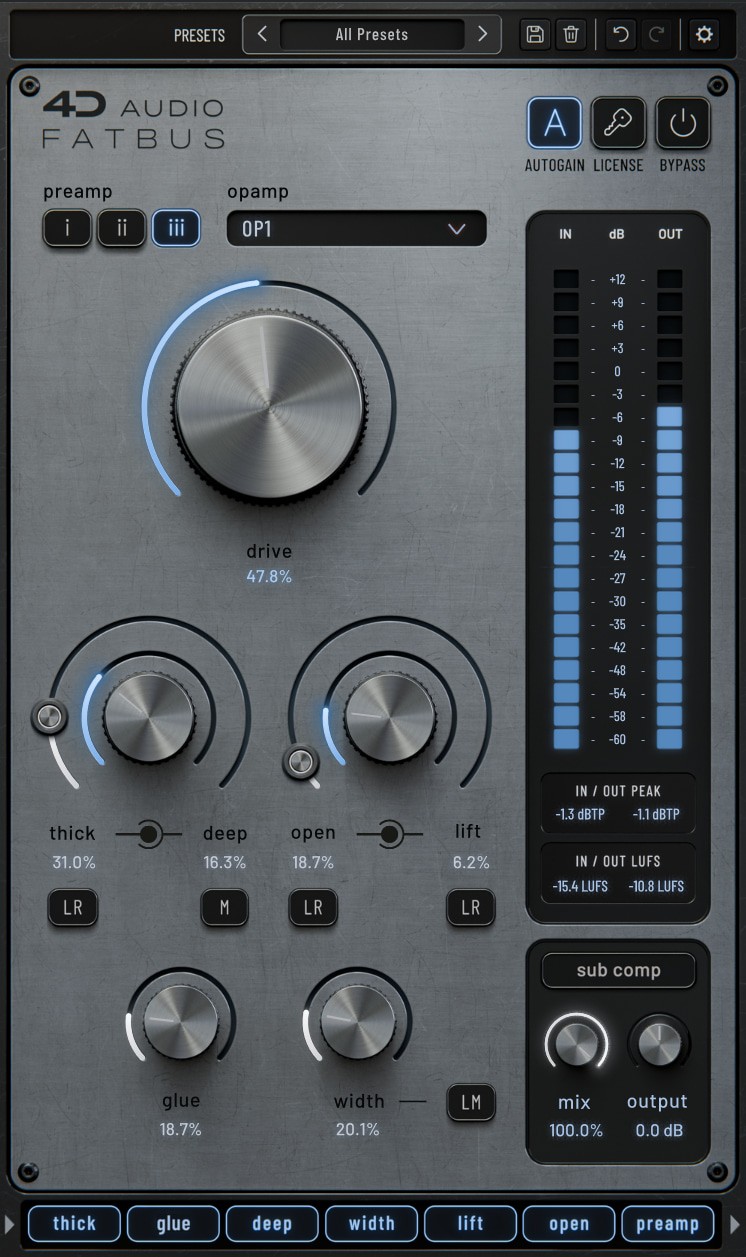
Front end
preamp
Three voices, from open and hifi to dense and punchy.Bus & mixbus preamps
opamp
Four classic opamps. Subtle when clean, obvious when driven.Classic opamp stages
drive
Pushes the preamp into soft clipping, just like the hardware.Preamp transformers
Tone
thick
Valve-style density and body.Early-2000s high-end converter, harmonic stage
deep
Smooth FET weight in the low end.German mastering harmonic unit, low band
open
Silky, subtle brightness that’s hard to overdo.British console channel, high end
lift
Open, hifi air on top.German mastering harmonic unit, high band
glue
Tape-style glue that pulls the mix together.Early-2000s high-end converter, tape stage
width
Side-only harmonics in the low or high mids. Mono-safe.German mastering harmonic unit, side mode
Output
sub
All the additional harmonic saturation can give the illusion that the low end is reduced. While the low end isn’t technically lower, this control adds a gentle shelf to the low end if you feel the need for a little bump. It is placed at the very end of the chain after the preamp section so as not to drive the preamp further.Low shelf · last in the chain
autogain
When autogain is enabled it will try to match the peak level of the input and output. This is only applied to the preamp/drive section, not the tonal controls.Preamp & drive only
By default, tone controls sit first in the chain and the preamp comes last. Reorder them however you like. Autogain keeps output matched while you move drive.
Rearrange the signal chain.
We couldn't unanimously agree on a signal order, so we've made the whole signal flow customisable depending on how clean or dirty you want it to sound. By default it's set up in the cleanest and, we think, the most ideal way. The idea that the preamp is placed last is to keep in check any peak levels that are raised by the tonal controls.

Compare fatbus on and off.
Pick a track, then a setting to hear it and see exactly how the plugin is set. Switch at any point; the playhead stays aligned.
Make sure to listen on monitors or headphones!
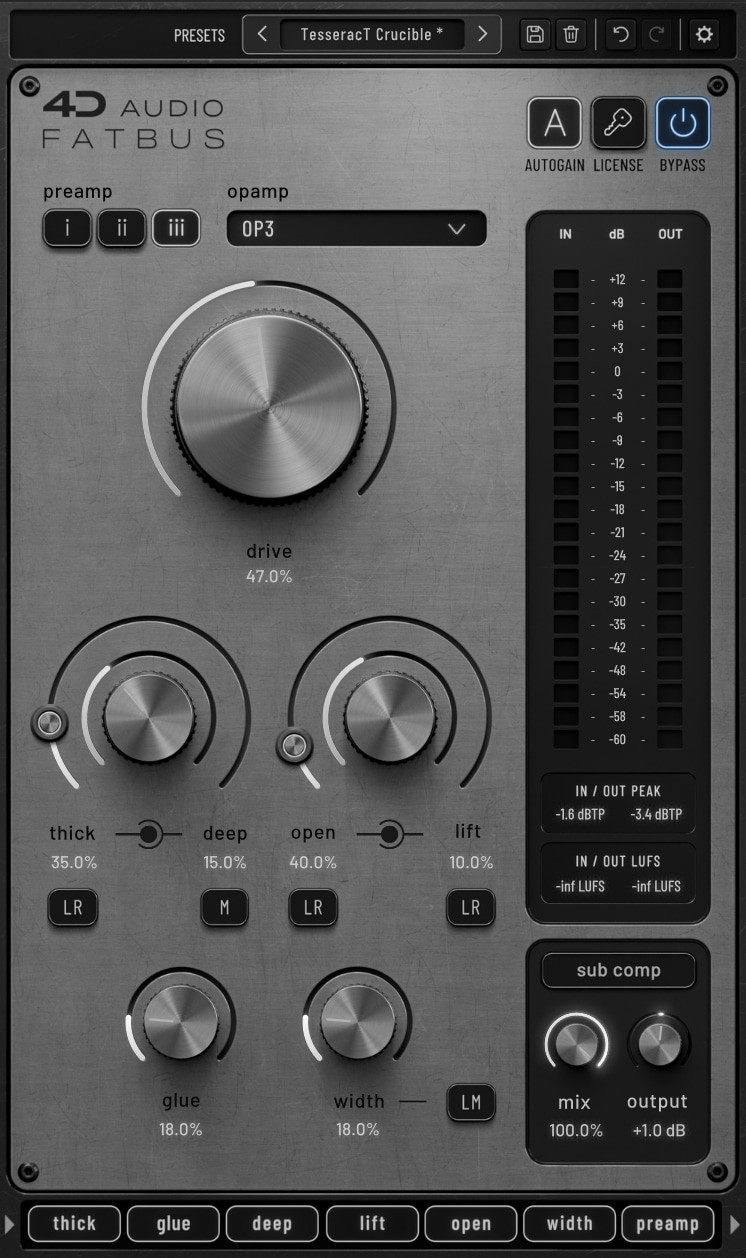
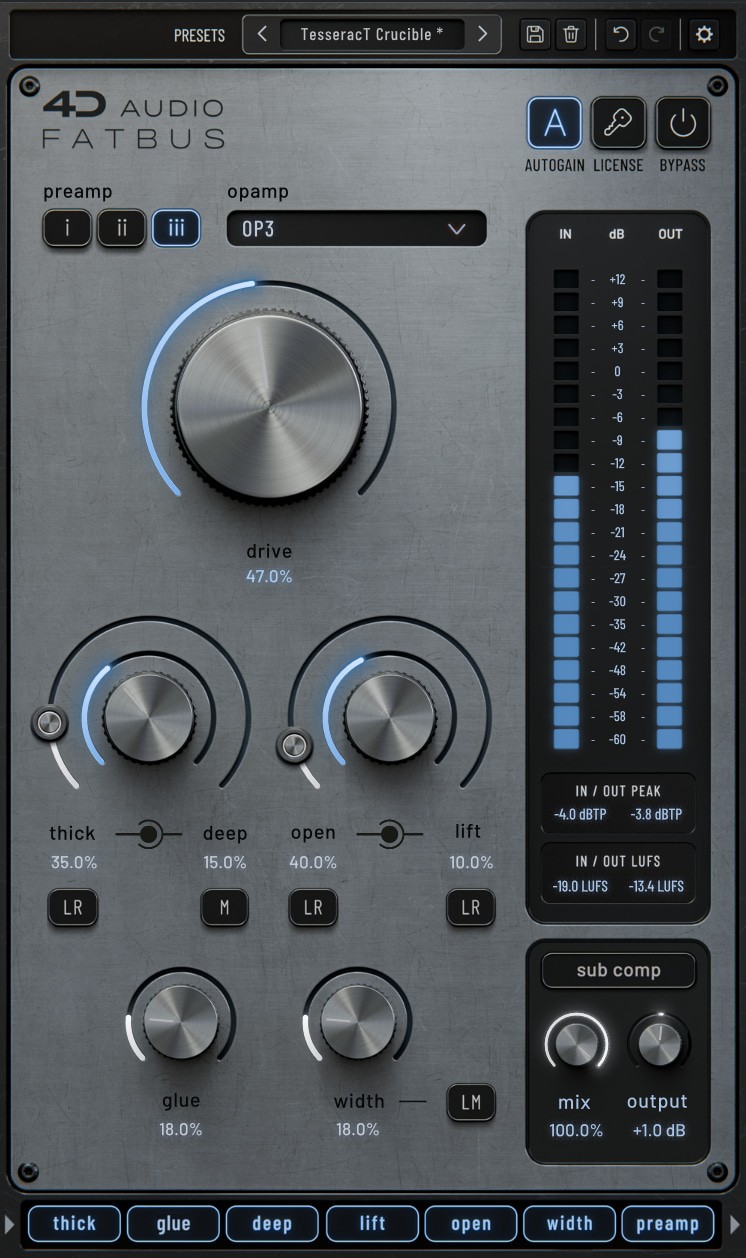
Every setting is peak-matched within 0.5dB. If there is a peak level difference, we've made it so that the "Fatbus Off" is always peaking louder.
See it in action.
Start with the one-minute overview, or take the full tour of every control and how the signal chain fits together.
Quick overview
fatbus in 60 seconds
Full walkthrough
Every control, step by step
What people think.
“Having my mixbus outboard chain in a plugin is a dream. It helps achieve that extra push. Plus I find it faster than working with outboard. It’s found its way onto my mastering projects and demos alike.”
 Acle KahneyTesseracT, Sylosis, Kalandra, Frank Carter & The Rattlesnakes
“Fatbus is refreshingly versatile. It tastefully adds character and vibe to anything I add it to. It’s a permanent fixture now.”
 Forrester SavellKarnivool, Animals As Leaders, Textures, Twelve Foot Ninja
“KILLER, instantly became part of my drum bus chain! Not only does it give me more headroom and control the transients very transparently (or not if you like it dirty!) but also the shaping features make it a delight to bring width and liveliness to my drum mix. Next level reached in no time!”
 Chris EdrichDevin Townsend, Leprous, Carpenter Brut, TesseracT, Arcane Roots
“Mixing into preamps and hitting transformers has always been something I’ve really enjoyed. Fatbus genuinely captures the sound and feel of mixing through outboard preamps, and the additional model options, opamp choices and tone controls make it incredibly versatile. It’s quickly become a go-to for me, and has already found its way onto many of my mixes!”
 Lewis JohnsEarthtone9, Loathe, Rolo Tomassi
Signature Response Modelling
The identity of a great piece of audio equipment reveals itself as you use it. In the texture that emerges when you push the input. In the way a transient passes through. In the subtle movement from clarity to colour.
These details are the starting point for Signature Response Modelling.
SRM is our own in-house approach to translating the behaviour of audio hardware into digital tools. It brings together careful measurement, signal processing and machine learning, with a modelling strategy shaped by the equipment itself.
We study how tonal balance, harmonic texture and level-dependent behaviour contribute to a piece of equipment’s character. For models with continuous controls, that work extends across the supported control range, because the journey between settings is part of the instrument.
Development moves between measurement and listening. We examine differences against the reference, refine the model, and evaluate the result inside the audio engine where it will be used. Processing efficiency and sonic fidelity are considered together.
Our methods remain behind the scenes. Their purpose is something you can hear and work with: distinctive character, responsive controls, and sound that earns its place in a session.
Measured with purpose.
Refined by listening.
A note from our developer
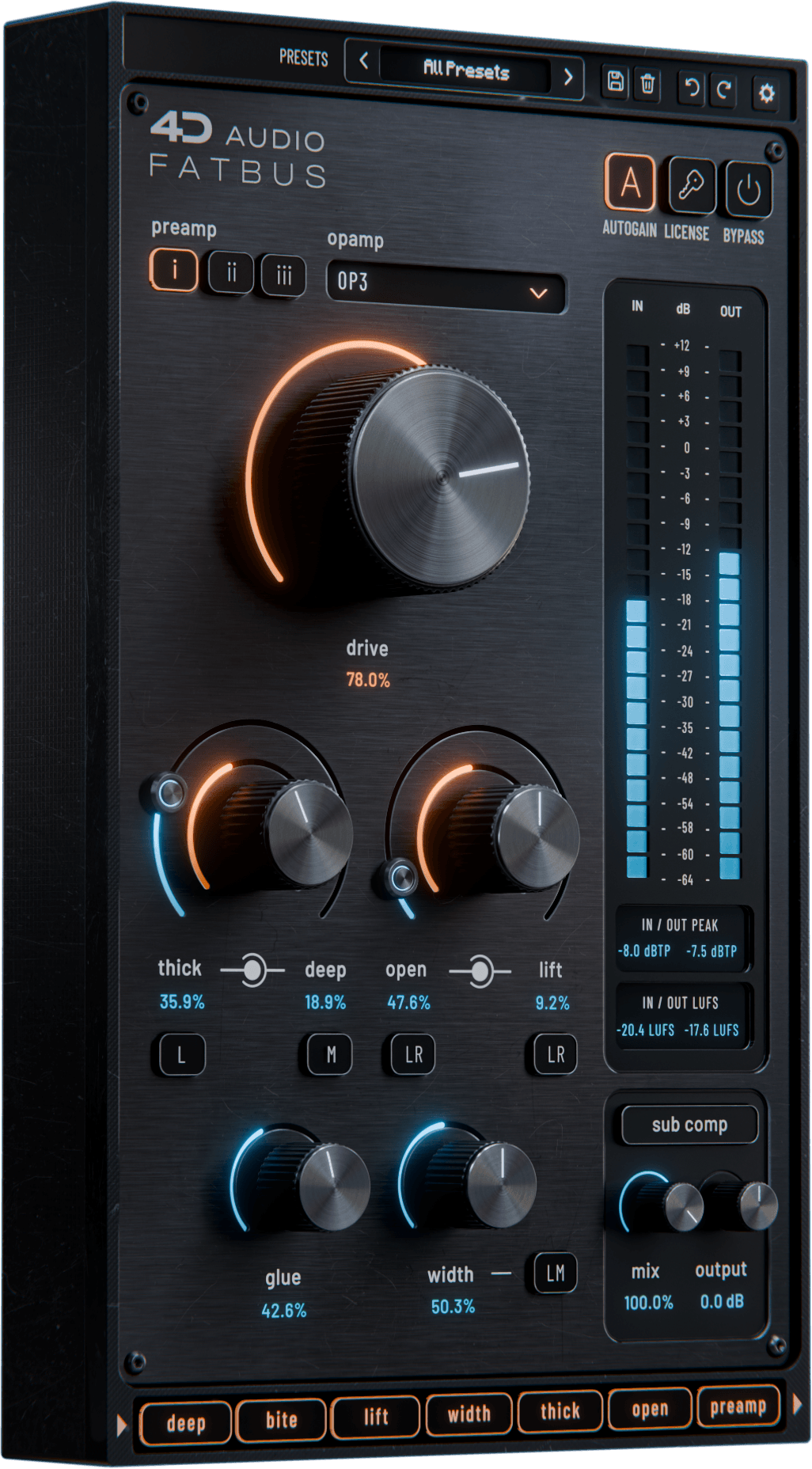
Every time we felt FatBus was finished, we found one more thing to test, one more thing to measure. We didn’t set any limits for creating it, and that made it more interesting. Only when we truly had nothing left to complain about did we know we’d made something unique.
Acle, Klevr Audio and I built this together, as friends who share the same obsession. This is FatBus.
19 rounds of listening notes in seven weeks, 16 of them from Acle Kahney.
Every figure on this page is measured or counted from our development records.
Download the free, restricted 7-day demo.
One preamp, one opamp, thick and open are available. The rest have been disabled.
The demo is fully functional for 7 days. While it runs, audio drops out briefly every 15 minutes during playback, and every 45 seconds when rendering or bouncing offline. Presets can’t be saved in the demo.
Please note: there are separate full and demo installers. Full installers are only available once the plugin is purchased.
Intro price, $45 off.
fatbus v1.0.0 · instant downloadMixbus saturation & tone shaping · digital licence
- VST3, AU & AAX installers
- Licence key emailed instantly
- Free 7-day demo available
Straight answers, no fine print.
What fatbus is, what it isn't, and the things worth knowing before you buy.
No. fatbus is not a model of one desk. It is a chain of separately captured units: bus preamps and opamps for the front end, and six mastering-grade tone stages behind the deep, thick, lift, open, glue and width controls.
There's no compressor in it, but a driven preamp stage does soften transients and tighten dynamics as a side effect. It is not a replacement for a bus compressor and a bus compressor would probably work best placed first in the chain before Fatbus.
Very low CPU and zero latency (0ms), so it is safe to track and play through live. Saturation is a non-linear process, and fatbus handles it internally without introducing any delay for your DAW to compensate for.
fatbus runs as a VST3, AU and AAX plugin in Pro Tools, Cubase, Nuendo, Logic, Reaper, Studio One and Ableton.
As this is a digital product, no refunds are offered. A free demo is available so you can be sure it's right for you before buying.
A small team of 5. The DSP and plugin are written by Moises D' Bello, concept by Acle Kahney, UI by Alex Marks. We do use machine learning, as a measurement tool, not a generator. Every model is trained on our own captures of the real hardware, then checked against it by measurement and by ear. Nothing here comes from a prompt: we know what every stage of the signal path does, and why it's there.